The trade that looked fine on paper
Picture a trader who has done the homework. They've watched some charts, read a few books, maybe followed a strategy from a YouTube video that made a lot of sense at the time. They open their first live account, fund it, and wait for a setup that matches everything they learned.
It shows up. The entry is clean. The stop-loss is placed exactly where the rules say it should be. On paper, this is a textbook trade.
Then the price starts moving against them by a few pips, and something strange happens. The trader who calmly identified this setup an hour ago is now staring at a small red number, feeling their stomach tighten. They move the stop-loss "just a little," telling themselves they're giving the trade more room to breathe. The price keeps falling. Eventually they close it, at a bigger loss than the plan ever called for.
Nothing about their analysis was wrong. What changed was that real money was now involved, and that can change how people act, even people who know better.
Losing money changes how you think, even when your strategy doesn't
This is one of the more uncomfortable truths in trading: a strategy that looks solid in theory can fall apart the moment it's tested with funds you actually care about. It's not that the trader forgot the rules. It's that risking real capital adds a layer of psychological pressure that simply doesn't exist when you're studying a chart after the fact.
For some traders, that pressure shows up in familiar ways. They hesitate before entering a setup they would have taken instantly on paper. They close a winning position early because they're afraid it will turn into a loss. They avoid a valid setup entirely because the last two trades didn't work out, even though this new setup has nothing to do with those previous ones. Decisions start getting filtered through the last outcome instead of the current chart.
None of this means the trader is undisciplined or bad at trading. It means they're human, and humans behave differently when there's something real on the line. The mechanics of trading — reading a chart, placing an order, managing a stop — are things you can learn without a single dollar at risk. Learning to make clear decisions under pressure is a separate skill, and it's much harder to build when every mistake is instantly billed to your account.
How one bad trade turns into several
There's a pattern that shows up often enough in trading communities that it has its own name: revenge trading. It rarely starts as a decision. It starts as a feeling.
A trader takes a loss. It wasn't even a bad trade, just one that didn't work out, which happens constantly in trading. But instead of moving on, a thought creeps in: I just need one more trade to get that back. So they look for another setup, except now they're not really looking for a good setup, they're looking for a fast one. They enter something that doesn't fully match their rules because waiting feels unbearable.
That trade loses too. Now there are two losses to recover instead of one, and the pressure to "fix it" is even stronger. Maybe the position size creeps up. Maybe they take a third trade they wouldn't have looked at twice on a calmer day. What started as a single, ordinary loss has turned into a losing streak driven almost entirely by emotion rather than analysis.
It's worth being clear about something: this isn't a beginner problem or a sign of low intelligence. Experienced traders fall into this same trap. The pull to "make it back right now" is a very normal human response to loss, and it tends to get stronger, not weaker, the more money is involved. Recognizing the pattern is far easier when you've encountered it somewhere the stakes were low enough to actually stop and think.
Why so many beginners quit before they've really started
There's a quieter consequence of early losses that doesn't get talked about as much as revenge trading, but might matter more in the long run.
A beginner opens a live account, takes a handful of losses in their first few weeks, and concludes that trading simply doesn't work for them. They stop. Maybe permanently.
The frustrating part is that this conclusion is often premature. Losses in the first weeks of trading rarely say much about whether someone could eventually become a competent trader. They usually say more about the fact that the person was learning to read charts, manage risk, follow a plan, and control their emotions all at once, while every mistake had a financial consequence attached to it.
Someone might have had a genuinely workable strategy and reasonable instincts, but they never got the chance to find out, because the financial pain of the learning curve arrived before the skill did. The issue often isn't that the person "can't trade." It's that they started paying tuition before the lessons had actually landed.
Having an idea is not the same as having a tested trading strategy
There's a gap between "I have a strategy" and "I have a strategy I've actually tested," and it's bigger than most beginners expect.
"I'll buy when the price breaks this level and sell near the previous high" is an idea. It's a reasonable starting point, but on its own it doesn't tell you anything about how that idea performs in the real world. How often does it actually win? What does it look like during a losing streak, because every strategy has one? Does it behave the same way in a trending market as it does in a choppy, sideways one? What's the realistic risk-to-reward ratio once slippage and hesitation are accounted for? And maybe most importantly, does the trader actually follow their own rules consistently, or do they quietly bend them when a trade starts to feel uncomfortable?
These are questions you can only answer by watching the strategy play out across many trades, in many different conditions. Waiting for that many real opportunities to occur naturally in live markets could take months, and by the time you have enough data, you may have already paid a steep price finding out the strategy needed adjustments.
Why practice trading deserves a place before real money does
None of this is an argument against trading, or a suggestion that real markets aren't the ultimate proving ground. They are. But there's a reasonable case for treating skill-building and capital-risking as two separate stages instead of doing both at once.
The mechanical parts of trading — chart reading, entries, exits, stop placement, position sizing, understanding risk-to-reward — can all be practiced without a cent on the line. So can the harder parts: sitting through a losing streak without panicking, sticking to a plan when a trade feels uncomfortable, and noticing your own patterns, like the urge to move a stop-loss the moment a trade goes red.
Separating "learning to trade" from "trading with money you need" doesn't remove difficulty from the process. It just changes when the financial stakes enter the picture, so that by the time they do, the decision-making underneath them is a little more solid.
The case for historical market replay
One of the most useful tools for this kind of practice is historical replay: going back through real market data and making trading decisions as though you were watching it happen in real time, without knowing what comes next.
This matters because it lets a trader ask the questions that actually build skill. Where would I enter here? Where would I put my stop? Would I actually follow my own rules, or would I second-guess myself? What happens if this trade loses, and then the next one loses too, would I still trust my process on the third setup?
The advantage over waiting for live opportunities is repetition. A trader might only see a handful of qualifying setups per month in live markets. Working through historical data, they can encounter dozens of similar situations in a much shorter span, which means patterns in their own decision-making show up faster, and get corrected faster too.
This isn't the same as backtesting
It's worth drawing a line here, because "historical data" can mean different things depending on the tool. Many traditional backtesting approaches start with a predefined set of rules, then run them against historical data to see what those rules would have produced, mechanically, without hesitation, fear, or second-guessing in the mix. It's a useful way to evaluate a strategy on paper.
What's often missing from that process is the human doing the trading. Backtesting can tell you what a fixed set of rules would have produced. It doesn't tell you whether you would have actually followed those rules in the moment, or what you would have done when a setup looked almost right but not quite. That's a different question, and it's the one that matters most once real money enters the picture. Practicing your own decision-making against historical situations, rather than only testing a rule set, is a way of getting closer to an answer.
This is where Chartamo comes in
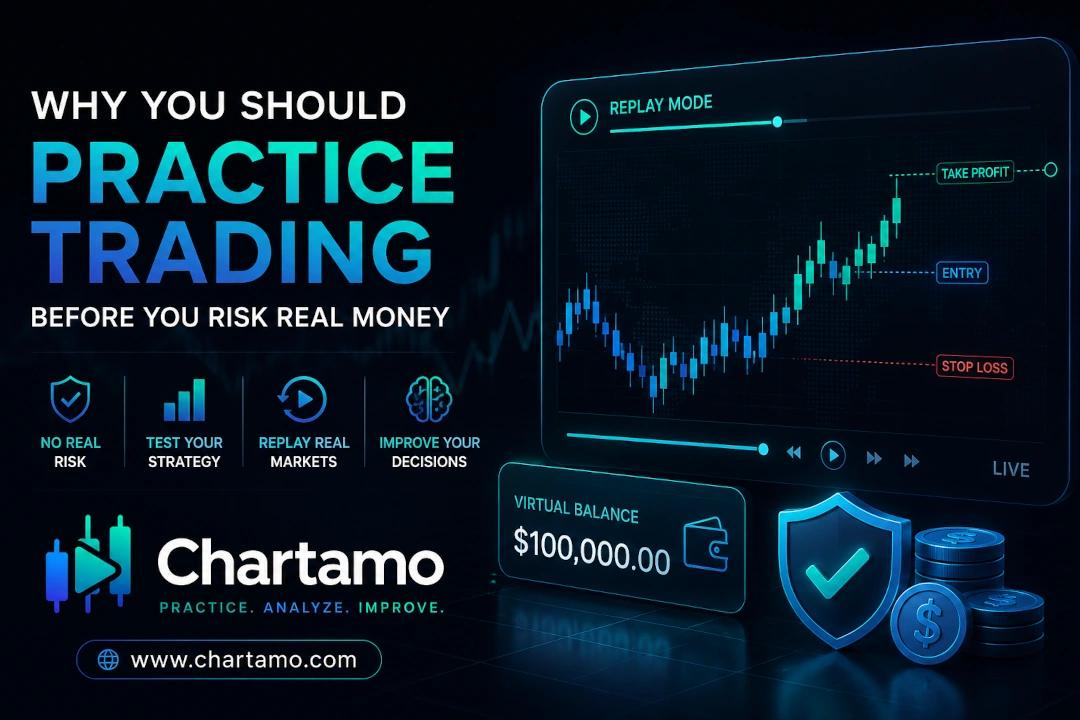
Chartamo is built around this exact idea: a place to practice trading using real historical market data and a virtual budget, before that same process gets applied to real capital.
Inside Chartamo, historical market situations are replayed candle by candle, so users make decisions the way they would in a live market, without knowing what happens next until they've already committed to a trade. You can practice entries and exits, place stop-losses and take-profits, and work through trades using a virtual budget instead of real funds. Afterward, you can review what you did, compare it to what actually happened, and start noticing your own tendencies, whether that's cutting winners short, hesitating on valid setups, or drifting from your own rules under pressure.
It's worth being precise about what this is and isn't. Chartamo doesn't predict the market, and it doesn't guarantee that a strategy which performs well in practice will perform the same way with real money on the line, because live trading always adds a psychological dimension that practice alone can't fully replicate. It isn't a broker or an exchange, it doesn't execute real trades, and it isn't financial advice. What it offers is more specific than any of that: a repeatable environment to test decisions, using real historical data, without your actual trading capital being the thing at risk while you're still learning.
That last part is worth being careful about too. Practicing without risking real money is genuinely valuable, but it isn't the same as trading with zero risk in any absolute sense. The uncertainty of markets, and the difficulty of making good decisions under pressure, don't disappear just because the capital does. What changes is that mistakes made during practice become lessons instead of losses.
Making repeated practice sustainable
Consistent practice is harder to sustain than it sounds, which is part of why Chartamo includes gamification elements like XP, levels, streaks, achievements, and challenges. The purpose of these isn't to encourage more risk-taking, quite the opposite, since there's no real capital involved in the first place. It's to make the process of showing up repeatedly, reviewing your decisions, and refining your approach feel less like a chore and more like something you actually want to keep doing.
The underlying loop stays simple: practice, analyze, improve. Not trade more to win more, but repeat the process enough times that your decision-making starts to become steadier, more consistent, and less reactive to whatever happened on the last trade.
A realistic way to think about it
Practice won't hand anyone a guarantee. Even a trader who has replayed hundreds of historical setups and refined their process carefully can still lose money in live markets, because markets are genuinely uncertain, and no amount of preparation removes that. That's not a flaw in the idea of practicing, it's just an honest limit on what practice can promise.
What practice can offer is a more prepared starting point. A trader who has already seen their strategy behave across dozens or hundreds of situations, who has already noticed their own tendency to move stop-losses or chase losses, and who has already built some comfort with losing streaks, is simply better positioned than someone encountering all of that for the first time with real money already on the table.
Before asking real capital to answer the question of whether a strategy and a process actually work, there's a reasonable argument for testing that process somewhere the answer doesn't cost you anything but time. Learn the mechanics, practice the decisions, test them against real historical situations, analyze what actually happened, and let that process shape you before your own money is the thing doing the teaching. That's the space Chartamo is built for, using historical data, a virtual budget, replay, and review, not as a promise of what real trading will bring, but as a way to arrive at it a little more prepared, and a little more aware of your own decision-making, than you otherwise would have been.