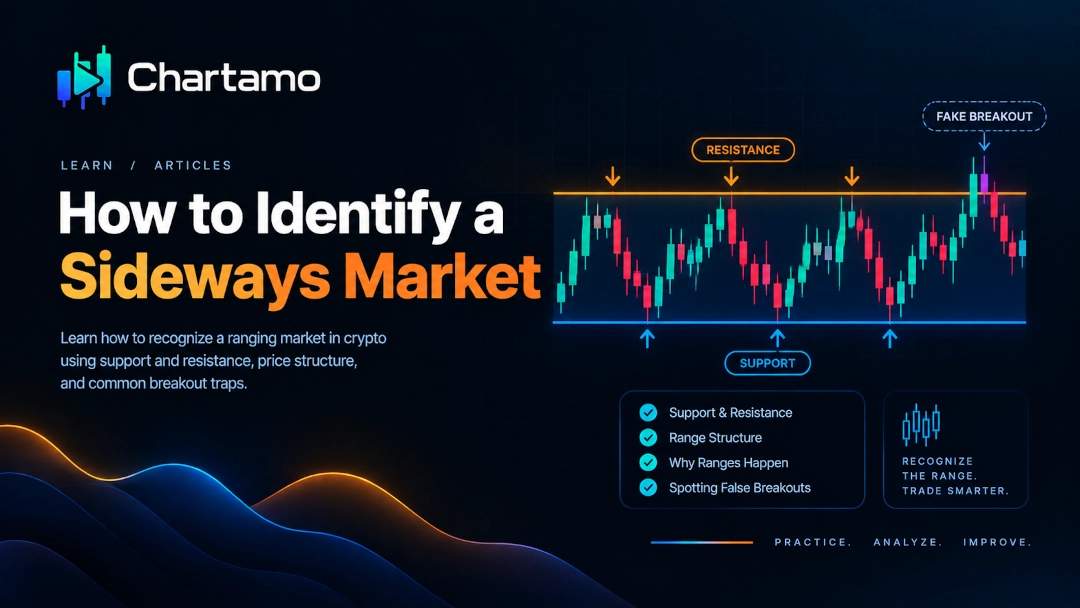
Sometimes the best description of a market is simply: it is not trending.
Price moves up. Then down. Then up again. The same areas are tested repeatedly, but neither buyers nor sellers manage to establish a clear directional structure.
This is a ranging market.
What Is a Ranging Market?
A ranging market is a market condition where price moves sideways between relatively defined areas of support and resistance.
Instead of a clean sequence of higher highs and higher lows, or lower highs and lower lows, price repeatedly returns toward the middle or opposite side of the range.
Resistance
────────────────────
       /\      /\
      /  \    /  \
     /    \  /    \
    /      \/      \
────────────────────
Support
The boundaries do not have to be perfectly horizontal. Real markets are rarely that neat.
Support and Resistance
Support is an area where buying interest has previously helped slow or reverse a decline.
Resistance is an area where selling pressure has previously helped slow or reverse an advance.
In a range, these areas can become particularly important because price may test them multiple times.
Think of them as areas, not exact lines.
Why Markets Range
A range can develop for many reasons.
Sometimes buyers and sellers are temporarily balanced. Sometimes the market is consolidating after a strong move. Sometimes participants are waiting for new information before committing to a direction.
You do not need to know the exact reason to identify the structure.
Why Breakouts Are Tricky
One of the biggest problems with ranges is the false breakout.
Price may move above resistance, attracting breakout buyers, and then quickly return inside the range.
The same can happen below support.
This does not mean every breakout is fake. It means that the first move outside a range is not automatically proof that a new trend has begun.
Range or Early Trend?
This is where context matters.
Suppose price moves above resistance and creates a new high.
That is interesting, but what happens next?
If price holds above the previous resistance area and establishes a higher low before continuing upward, the market may be transitioning into an uptrend.
If price immediately falls back inside the previous range, the breakout may have failed.
Do Not Force a Direction
A common trading mistake is assuming that every market must be either bullish or bearish.
It does not.
Recognizing a range can be just as valuable as identifying a trend because it changes how you interpret price movement.
A move that looks like a reversal inside a strong trend may simply be normal volatility. A move that looks like a breakout may simply be a range expansion that fails.
Questions to Ask
- Are meaningful highs consistently getting higher?
- Are meaningful lows consistently getting higher?
- Are meaningful highs consistently getting lower?
- Are meaningful lows consistently getting lower?
- Or is price repeatedly moving between similar areas?
If the last description fits best, you may be looking at a range.
Related Guides
Practice identifying ranges and breakouts without knowing what happens next.