Reading about market trends can teach you the concepts.
Practice is what turns those concepts into a skill.
The problem with studying historical charts is that you already know what happened. Once the entire chart is visible, a trend can look obvious even when it would have been difficult to identify in real time.
That is why practicing without seeing the future matters.
What Should You Practice?
Start with a simple question:
What is the current market structure?
Do not try to predict the next candle yet.
First classify what you can actually see:
- Uptrend
- Downtrend
- Ranging market
Step 1: Find the Swing Points
Look for meaningful swing highs and swing lows.
Do not mark every tiny movement. You are trying to understand the structure of the market, not reproduce every fluctuation.
Step 2: Classify the Structure
Ask whether price is generally creating:
- Higher highs and higher lows
- Lower highs and lower lows
- Neither consistently
The answer gives you a starting classification.
Step 3: Look for Structural Changes
If the market has been trending upward, watch what happens around important higher lows.
If one of those levels breaks, do not immediately declare a downtrend.
Instead, observe what happens next.
The same principle applies to a downtrend and its lower highs.
Step 4: Make Your Call Before Revealing the Future
This is where the exercise becomes useful.
Before seeing the next part of the chart, record your current interpretation:
Uptrend / Downtrend / Range
Then continue the replay and see what happened.
You are not trying to make every prediction correct.
You are testing whether your reasoning was consistent with the information available at the time.
What You Should Learn From a Wrong Answer
Suppose you classified a market as an uptrend, but price suddenly collapsed.
That does not automatically mean your analysis was bad.
Ask a more useful question:
Was the bullish structure already broken when I made the decision?
If it was not, then the market simply did something you could not know in advance.
If it was, you may have missed an important structural warning.
That distinction is far more valuable than simply counting wins and losses.
Practice Different Market Conditions
Do not practice only clean trends.
Real markets include:
- Strong trends
- Weak trends
- Deep pullbacks
- Ranges
- False breakouts
- Trend transitions
Learning to recognize uncertainty is part of becoming better at reading charts.
Practice Without Real Money
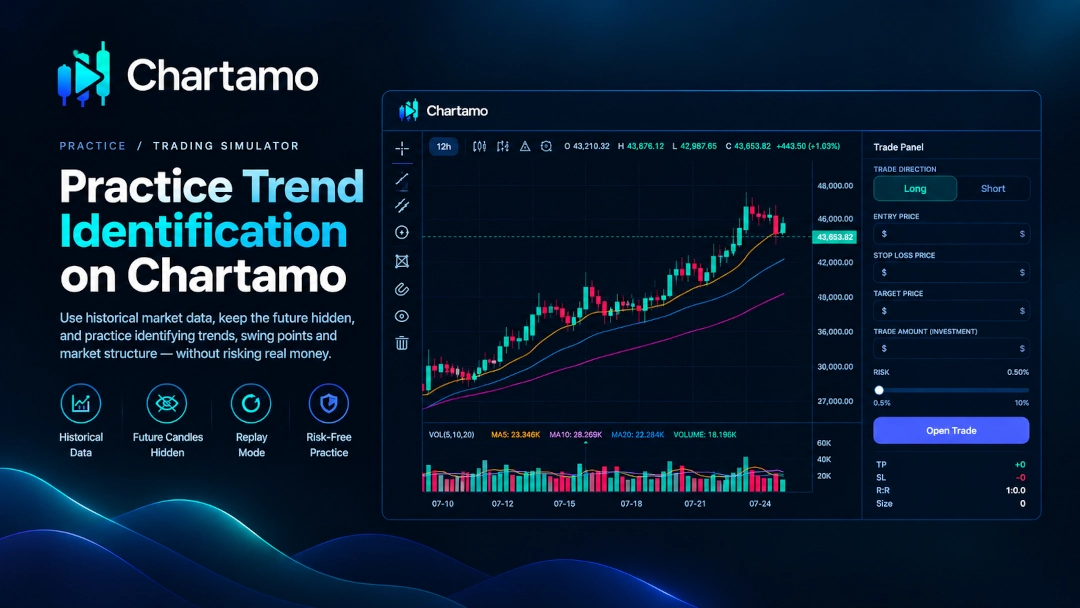
Chartamo is designed to let you practice market analysis using historical price action without risking real capital.
You can replay market movements, make decisions as the chart develops, and compare your interpretation with what happened next.
The goal is not to pretend that trading is predictable.
The goal is to become better at making decisions from incomplete information.
Ready to Practice?
You have now covered the basic framework:
- What a market trend is
- How to identify an uptrend
- How to identify a downtrend
- How to identify a range
- How to spot a potential reversal
- How to confirm a trend
- How to avoid common mistakes
Now the useful part begins.