Calling a trend reversal too early is one of the easiest ways to get trapped.
Price falls sharply, a large green candle appears, and suddenly the chart looks bullish. Or price has been rising for hours, prints a large red candle, and everyone starts talking about a crash.
Neither reaction is enough to confirm a reversal.
A better approach is to watch for a change in market structure.
What Is a Trend Reversal?
A trend reversal occurs when an existing directional market structure changes and begins developing in the opposite direction.
An important word here is developing.
A reversal is often a process rather than a single event.
Weakness Before the Reversal
Trends can show signs of weakening before their structure actually reverses.
For example, an uptrend may continue making higher highs, but each new advance becomes less convincing. Pullbacks may become deeper, or price may struggle to establish a strong new high.
These are warnings, not confirmations.
Break of Structure
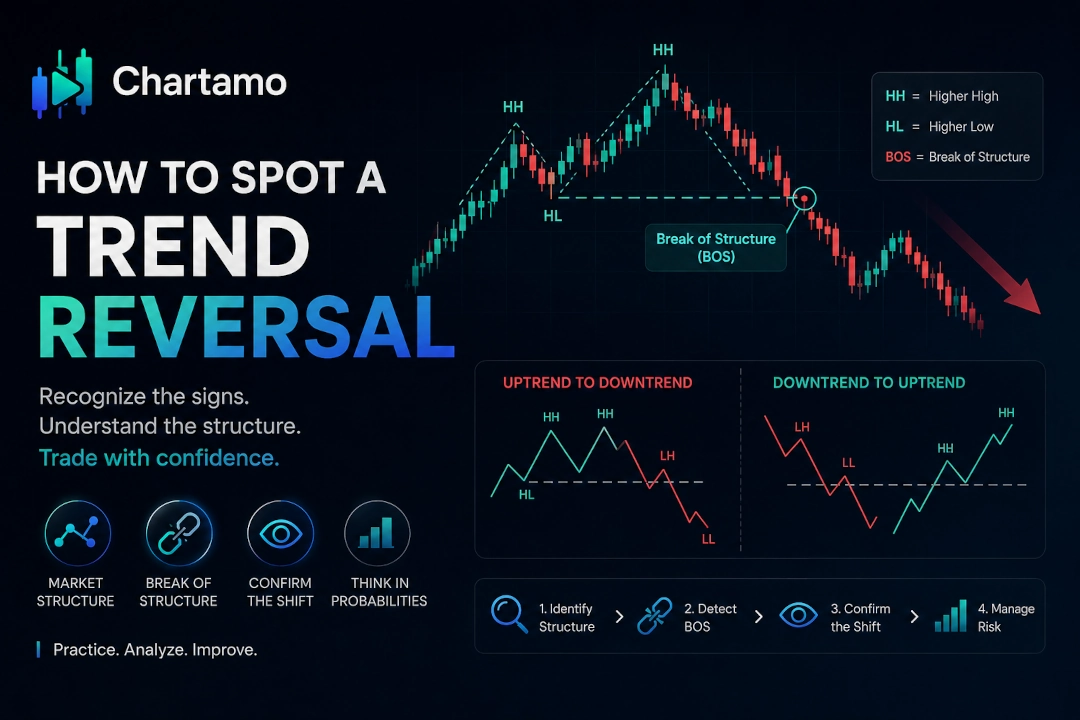
Break of Structure (BOS) is commonly used to describe price breaking an important structural level.
In an uptrend, a meaningful break below a key higher low can indicate that the previous bullish structure has been damaged.
In a downtrend, a meaningful break above a key lower high can indicate that bearish structure has weakened.
However, a BOS does not automatically guarantee a complete reversal.
From Uptrend to Potential Downtrend
Imagine a market creating:
HH → HL → HH → HL
Then price falls below the latest important HL.
That is a meaningful change.
But the next question is what happens after the break.
If price rallies and creates a lower high, then falls again and creates a lower low, the evidence for a bearish transition becomes much stronger.
From Downtrend to Potential Uptrend
The same logic works in reverse.
A bearish market may create:
LL → LH → LL → LH
If price then breaks above an important LH, bearish structure has weakened.
If subsequent price action establishes a higher low and then a higher high, the case for a developing uptrend becomes stronger.
Do Not Confuse a Pullback With a Reversal
This is one of the most important distinctions in trend analysis.
A pullback moves against the existing trend while leaving its important structure intact.
A reversal involves a meaningful change in that structure.
For example, a red move inside an uptrend is not automatically a reversal. If the move ends above the important previous swing low and price resumes upward, it was simply a pullback.
There Is No Magic Reversal Candle
Patterns and indicators can be useful tools, but no single candle guarantees that a trend has reversed.
A reversal should be evaluated in context:
- What was the previous trend?
- Which structural level was broken?
- Was the break sustained?
- What happened after the break?
Think in Probabilities
Technical analysis does not provide certainty.
A structure can suggest that a reversal is becoming more likely without guaranteeing what happens next.
That is a useful mindset because it keeps your analysis tied to evidence rather than confidence.
Related Guides
The fastest way to improve this skill is to practice reading structure without seeing the future.